Finding a jewelry manufacturer is only the beginning. Before paying for a sample, a small jewelry business needs to understand exactly what the manufacturer can produce, how the minimum order quantity is calculated, what the sample fee includes, and whether the approved sample can be reproduced consistently in bulk production.
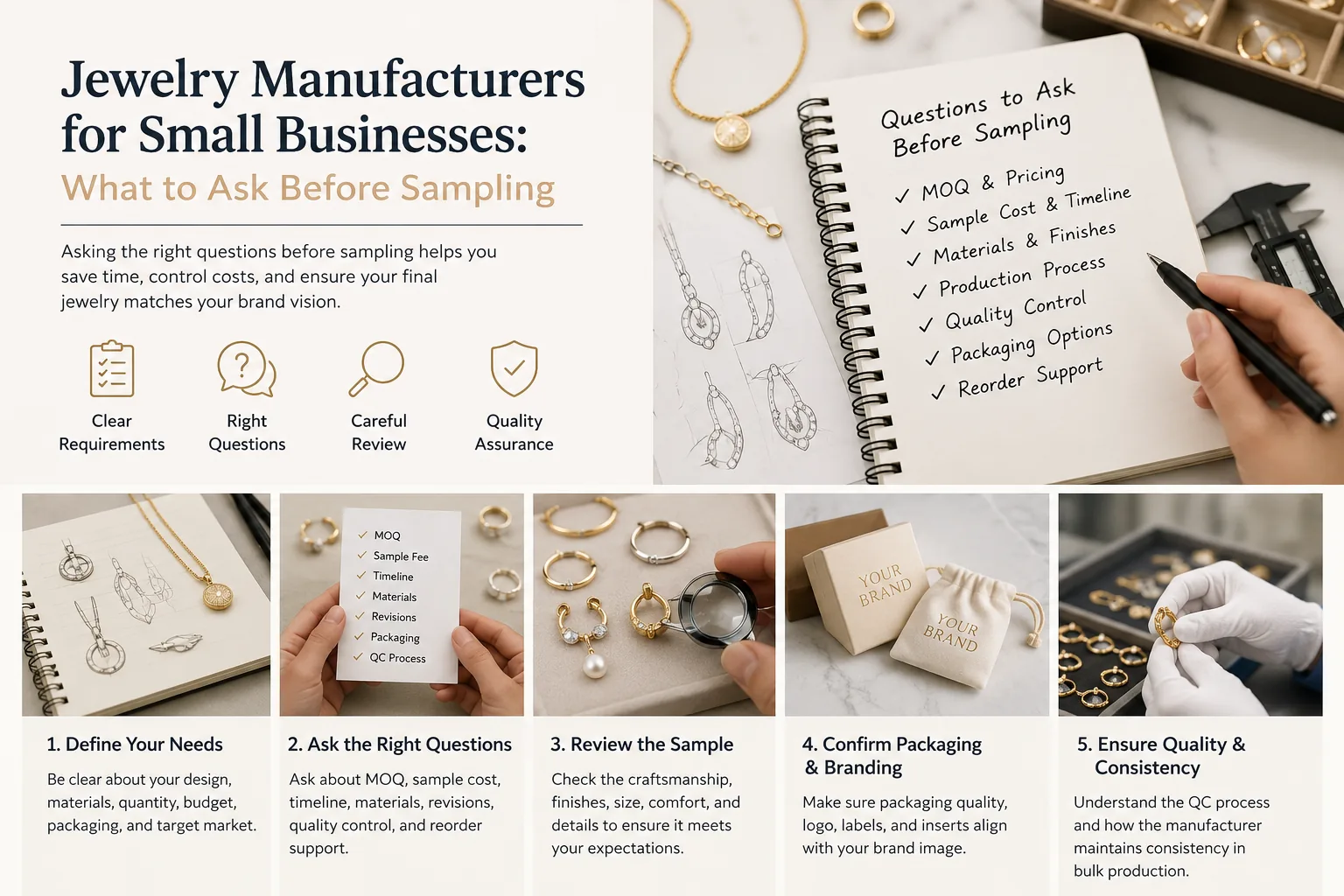
This matters because small brands usually have less room for expensive revisions, excess inventory, unclear production costs, or delayed launches. A supplier may appear suitable based on a website or quotation, but the details of sampling, quality control, packaging, and reorders often determine whether the relationship works in practice.
A reliable custom jewelry manufacturer for small brands should be able to explain the development process clearly before sampling begins. This guide covers the questions small businesses should ask, the information they should prepare, and the details they should check before approving a sample for production.
What Small Businesses Need from a Jewelry Manufacturer
Large jewelry companies may place high-volume orders, work with dedicated sourcing teams, and manage several manufacturers at once. A startup brand, boutique, or ecommerce seller usually needs a different type of support.
Small businesses often need a manufacturing partner that can help them:
- Develop a product from a sketch, reference image, existing sample, or product brief
- Start with a manageable initial production quantity
- Review samples before committing to bulk production
- Add logos, branded cards, pouches, boxes, or other private label elements
- Keep specifications organized for future reorders
- Communicate clearly about costs, revisions, production schedules, and quality expectations
The lowest quotation is not always the most suitable option. For a small brand, clarity and flexibility can be more valuable than a low unit price that excludes development, packaging, inspections, or revisions.
A manageable first production order
A manufacturer may advertise a low MOQ, but the number alone does not explain how the MOQ works.
It may be calculated:
- Per design
- Per color or plating finish
- Per size
- Per material
- Per logo version
- Per packaging type
- Across the complete order
For example, an MOQ described as 100 pieces may mean 100 pieces of one design and one finish—not 100 mixed pieces across ten styles.
Before sampling, ask how the MOQ applies to your actual collection. You should also confirm whether the reorder MOQ is the same as the initial production MOQ.
A clear route from idea to sample
Different jewelry manufacturers provide different levels of development support.
Some work mainly from complete technical drawings or CAD files. Others can review sketches, reference photos, dimensions, material preferences, and branding ideas.
The manufacturer should explain:
- What information is needed from you
- Whether CAD or technical drawings are required
- Which design elements can be customized
- Whether molds or special tooling are necessary
- How revisions will be recorded
- How the final sample will be approved
Support beyond the first order
A sample is not just a one-time prototype. Ideally, it becomes the reference for bulk production and future reorders.
Ask whether the manufacturer keeps:
- Approved CAD files
- Final measurements
- Material and finish specifications
- Logo placement details
- Packaging requirements
- Production notes
- Revision history
This documentation can help reduce inconsistencies when you reorder or expand the collection.
Decide What Type of Jewelry Manufacturer You Need
Before contacting suppliers, determine which manufacturing model matches your project.
| Manufacturing option | What it usually involves | Most suitable for |
|---|---|---|
| Custom jewelry manufacturing | Developing jewelry from an original concept, drawing, sample, or detailed brief | Brands creating original products |
| OEM jewelry manufacturing | Producing jewelry according to specifications provided by the brand | Brands with established designs or CAD files |
| ODM jewelry manufacturing | Selecting and adapting designs developed by the manufacturer | Brands seeking a faster product-development route |
| Private label jewelry | Applying branding or packaging to existing or lightly modified designs | Brands testing a collection with less development |
| Wholesale jewelry supply | Purchasing ready-made products for resale | Boutiques and retailers that do not require product development |
A custom manufacturer may be more appropriate when you need original shapes, specific dimensions, logo application, sample revisions, coordinated packaging, and repeat production.
A private label supplier may be suitable when speed and lower development complexity are more important than creating a completely original design.
Neither option is automatically better. The right choice depends on your budget, launch schedule, product positioning, and customization requirements.
What to Prepare Before Contacting a Jewelry Manufacturer
Manufacturers can provide more useful answers when they receive a clear product brief.
Without enough detail, quotations may be based on different assumptions, making it difficult to compare suppliers accurately.
Product category and collection size
Start by defining:
- Product type: necklaces, earrings, bracelets, rings, charms, or other items
- Number of designs
- Number of finishes or colors
- Size variations
- Expected quantity per design
- Whether the products belong to one coordinated collection
Design references and customization level
Prepare any available:
- Sketches
- Reference photographs
- Existing samples
- Technical drawings
- Approximate measurements
- Logo files
- Material preferences
- Finish references
- Packaging ideas
Reference photographs can communicate the visual direction, but they should not be treated as complete production specifications.
If a particular dimension, logo position, clasp type, stone layout, or finish is important, include it in writing.
Estimated quantity and launch schedule
You do not need a perfect forecast, but you should be able to provide:
- An estimated first-order quantity
- The number of designs
- Your preferred sample approval period
- Your target launch window
- Whether you expect regular reorders
The manufacturer can then assess whether the schedule and production method are realistic.
Target positioning and budget range
A target cost is not only about negotiating the lowest price. It helps the manufacturer understand which materials, components, finishes, packaging options, and production methods may be appropriate.
Be clear about whether the jewelry is intended for:
- Entry-level fashion retail
- Boutique collections
- Online-first brands
- Seasonal product drops
- Gift-focused collections
- Higher-priced branded collections
15 Questions to Ask a Jewelry Manufacturer Before Sampling
The following questions will help you compare jewelry manufacturers for small businesses before paying for development or sample production.
1. Do You Support My Product Type and Customization Requirements?
Do not ask only, “Can you make this?”
Instead, ask the manufacturer to explain:
- Whether it has experience with the product category
- Which parts of the design can be customized
- Whether it can work from sketches or reference images
- Whether CAD development is available
- Which processes are completed internally
- Whether any specialist work is outsourced
- Whether branded packaging can be coordinated with production
A useful response should explain the manufacturing route rather than simply saying that the design is possible.
2. How Is the MOQ Calculated?
Ask whether the minimum order quantity applies:
- Per design
- Per finish
- Per color
- Per size
- Per material
- Per order
- Per packaging option
Also ask whether several designs can be combined to reach the minimum quantity.
Brands planning a smaller first collection should review the manufacturer’s low MOQ jewelry manufacturing options before assuming that the advertised MOQ applies to the entire order.
You should also confirm:
- Initial production MOQ
- Reorder MOQ
- MOQ for custom packaging
- MOQ for logo application
- Whether different finishes can be mixed
3. What Is Included in the Sample Fee?
A sample quotation may include only the physical item, or it may also include development work.
Ask whether the fee covers:
- CAD or technical drawing
- Mold or tooling
- Base material
- Stones or decorative components
- Plating or finishing
- Logo application
- Packaging sample
- Revision rounds
- Sample shipping
Two sample quotations cannot be compared accurately unless they cover the same scope.
A lower quotation may exclude tooling, revisions, packaging, or international shipping.
4. Are Development Costs Reusable or Deductible?
Custom products may require CAD work, molds, stamping tools, custom components, or other development costs.
Ask:
- Whether the mold can be reused for production
- Whether tooling fees are charged once or per order
- Whether any sample fees may be credited against a production order
- Whether major revisions require new tooling
- Whether the manufacturer keeps the mold for reorders
- How long development files and tooling are retained
Do not assume that development costs will automatically be deducted from a bulk order. The policy should be confirmed in writing.
5. How Many Sample Revisions Are Included?
The first sample may reveal issues with dimensions, finish, proportions, logo placement, components, or wearability.
Before paying, confirm:
- How many revision rounds are included
- Which changes are considered minor
- Which changes require an additional fee
- Whether a new mold is needed for structural changes
- How revision instructions should be submitted
- Whether the sample timeline restarts after a revision
A clear revision policy helps prevent disagreements after the first sample arrives.
6. What Materials, Finishes, and Components Will Be Used?
Ask the manufacturer to document the planned specifications before sampling.
These may include:
- Base material
- Surface finish
- Plating direction
- Stone or decorative component
- Chain type
- Clasp
- Earring post
- Jump rings
- Logo method
- Main dimensions
- Weight range, when relevant
Avoid relying on broad terms such as “premium quality” without a detailed description of what will actually be used.
Claims relating to water resistance, tarnish performance, skin sensitivity, or material compliance should only be used when appropriate testing or documentation is available.
Need help preparing your first jewelry sample?
Share your product idea, target quantity, material preference, and packaging needs. Our team can help you review sampling options before bulk production.
7. Will Bulk Production Use the Same Specifications as the Approved Sample?
This is one of the most important questions to ask.
A visually attractive sample is not useful if bulk production will use a different material, component, production method, or finish.
Ask:
- Whether the sample uses production-intended materials
- Whether the sample is handmade or produced using the expected bulk process
- Which differences may exist between the sample and production units
- Whether the approved sample will be retained as a reference
- Which written specifications will control production
- How acceptable production variations will be defined
The final sample, CAD file, dimensions, materials, finish, and revision notes should all support the production approval.
A simple message saying “the sample looks good” is not a complete production specification.
8. How Long Does Sampling Take, and When Does the Timeline Begin?
A sample timeline may begin after:
- Payment
- Design confirmation
- CAD approval
- Material confirmation
- Mold completion
- Receipt of a physical reference sample
Ask the manufacturer to separate the estimated time for:
- Design review
- CAD or drawing preparation
- Mold or tooling
- First sample
- Revision
- Final sample approval
Sampling time depends on the design, material, finish, components, tooling, and number of revisions. A realistic schedule should be based on the actual project rather than a general promise.
9. How Will the Final Sample Be Approved?
Define the approval process before production begins.
Possible approval records include:
- A physical sample
- Approved photographs or video
- Final CAD file
- Measurement sheet
- Written material and finish specifications
- Logo placement confirmation
- Packaging instructions
- A numbered revision list
For products with important tactile, dimensional, or functional details, a physical sample may provide information that photographs cannot show.
Both parties should know which version is considered final.
10. What Quality Checks Are Performed Before Shipment?
Ask the manufacturer to explain the pre-shipment jewelry quality checks relevant to your products.
Checks may cover:
- Dimensions
- Shape and proportions
- Surface appearance
- Finish consistency
- Logo placement
- Stone setting
- Clasps and moving parts
- Earring posts
- Chain connections
- Quantity
- Packaging
- Visible damage
Also ask:
- Whether every piece or a sample of the order is checked
- Who performs the inspection
- Whether inspection photos or reports are available
- How approved specifications are used during QC
- When the inspection takes place
The quality-control plan should reflect the design and order requirements rather than rely only on a generic statement.
11. How Are Defects and Production Variations Handled?
Jewelry production may involve acceptable variations, but these should not be confused with defects.
Before ordering, discuss:
- How a defect is defined
- Which variations may be considered acceptable
- How issues should be documented
- The period for reporting problems
- Whether repair, replacement, credit, or another solution may apply
- Who is responsible for return or replacement shipping
- How repeated problems are prevented in future orders
The exact solution depends on the manufacturer’s policy and the order terms. Confirm it before production rather than after a problem occurs.
12. What Does the Bulk Production Quotation Include?
Ask for a quotation that separates the relevant costs.
These may include:
- Unit cost
- Mold or tooling
- CAD or design development
- Logo customization
- Special components
- Packaging
- Packaging assembly
- Quality inspection
- Sample shipping
- Bulk shipping
- Taxes, duties, or import-related costs where applicable
A low unit price may not represent the final landed cost of the collection.
When comparing manufacturers, make sure each quotation is based on the same materials, finish, quantity, packaging, inspection scope, and shipping terms.
13. Can You Support Private Label Packaging?
Packaging may be part of the brand experience, but it can also introduce additional MOQs, development costs, and lead times.
Ask whether the manufacturer can support:
- Jewelry cards
- Logo cards
- Pouches
- Boxes
- Stickers
- Care cards
- Barcode labels
- Product labels
- Outer cartons
- Packing and assembly
Review the available private label jewelry packaging options and confirm:
- Packaging MOQ
- Sample cost
- Printing method
- Color limitations
- File requirements
- Packaging production time
- Whether packaging can be sampled with the jewelry
- Whether the manufacturer will pack the finished order
Do not approve packaging based only on a digital mockup when size, color, print quality, or product fit is important.
14. How Will Reorders Be Managed?
A manufacturer that can make the first order is not necessarily prepared to reproduce it consistently later.
Ask:
- Whether final specifications are stored
- Whether CAD files and molds are retained
- Whether the approved sample is kept
- Whether a reorder requires a new sample
- Whether the reorder MOQ is different
- Whether materials and components may change
- How unavailable components will be handled
- How batch consistency is reviewed
- Whether new products can be developed to match the original collection
For a small brand, repeatability can be as important as the first sample.
Clear records reduce the need to explain the same product again during every reorder.
15. Who Will Be My Main Contact?
Ask who will manage communication during:
- Design review
- Sampling
- Quotation
- Revisions
- Production
- Quality control
- Shipping
- Reorders
Also confirm:
- Preferred communication channel
- Typical response process
- How production updates are provided
- How changes are approved
- Who should be contacted if a problem occurs
Important decisions should be recorded in writing, even when discussions take place through calls or messaging apps.
Use a Sample Brief, Not Just Reference Photos
Reference images are useful, but different people may interpret the same photograph differently.
A sample brief should include the details that matter to your brand.
Basic sample brief checklist
Product information
- Product name or reference number
- Product category
- Main dimensions
- Size variations
- Estimated quantity
Design details
- Sketch or reference image
- Shape and proportions
- Chain, clasp, post, or connector type
- Stone or decorative component details
- Logo size and location
Material and finish
- Preferred base material
- Finish direction
- Color reference
- Texture
- Areas that should or should not be polished
Packaging
- Card, pouch, box, or other packaging
- Logo file
- Packaging dimensions
- Label or barcode requirements
Project information
- Target sample date
- Target launch period
- Expected production quantity
- Approval-critical details
Mark the details that cannot change without your written approval.
How to Compare Jewelry Manufacturers for Small Businesses
Instead of choosing a manufacturer based on one quotation, compare each candidate using the same criteria.
| Comparison item | Manufacturer A | Manufacturer B | Manufacturer C |
|---|---|---|---|
| Manufacturing model | |||
| Customization capability | |||
| MOQ calculation | |||
| Sample fee scope | |||
| Revision policy | |||
| Sample timeline | |||
| Materials and finishes | |||
| Packaging support | |||
| Quality-control process | |||
| Production timeline | |||
| Reorder support | |||
| Communication clarity | |||
| Estimated total cost |
A useful comparison should consider:
- Whether the manufacturer understands the design
- Whether the quotation is complete
- Whether the MOQ fits the collection plan
- Whether revisions are manageable
- Whether quality expectations can be documented
- Whether the manufacturer can support packaging and reorders
- Whether communication is clear and consistent
The cheapest sample is not necessarily the lowest-risk option.
Red Flags Before Paying for a Jewelry Sample
Some warning signs can be identified before any money is paid.
The quotation does not explain what is included
A single number without materials, finish, development, revisions, packaging, or shipping details is difficult to evaluate.
The MOQ changes without explanation
MOQ may change after the manufacturer reviews the design, but the reason should be explained. Tooling, materials, finishes, components, and production methods can affect the minimum quantity.
Materials and finishes remain vague
Descriptions such as “good material” or “high-quality plating” are not detailed enough for production approval.
Important decisions are not confirmed in writing
Verbal discussions are useful, but dimensions, materials, prices, revisions, and approval details should be documented.
Unlimited customization is promised immediately
A manufacturer should review the design before confirming feasibility, cost, tooling, MOQ, and timeline.
The sample is not connected to production specifications
If the manufacturer cannot explain how the approved sample will guide bulk production, inconsistencies may be more difficult to prevent.
There is no clear process for revisions or defects
A professional sampling process should explain what happens when changes are needed or production issues are found.
What to Check When the Jewelry Sample Arrives
Receiving the sample is not the end of the sampling process. It is the point at which the product should be checked against the original brief.
Compare it with the approved design
Review:
- Dimensions
- Shape
- Proportions
- Finish
- Color direction
- Logo position
- Stone layout
- Chain or component length
- Packaging fit
Measure important details rather than relying only on visual impressions.
Check functional details
Depending on the product, check:
- Clasp operation
- Earring post alignment
- Chain movement
- Stone security
- Connector strength
- Smoothness of edges
- Comfort during wear
- Whether moving parts operate correctly
Check whether it fits the collection
Ask:
- Does it match the brand’s visual direction?
- Does it work with the planned packaging?
- Does it feel appropriate for the intended price position?
- Does it coordinate with the other products?
- Is it suitable for photography, display, and shipping?
A technically acceptable sample may still need revision if it does not fit the brand or collection.
Record every approved change
Before bulk production, confirm:
- Final CAD or drawing
- Final dimensions
- Material
- Finish
- Components
- Logo
- Packaging
- Revision history
- Approved physical sample or visual reference
You can also review jewelry samples before bulk production through a structured sample-first development process.
Manufacturer, Supplier, or Vendor: Which One Do You Need?
The terms manufacturer, supplier, and vendor are sometimes used interchangeably, but they may describe different types of support.
A manufacturer is generally more suitable when you need:
- Original product development
- CAD or technical support
- Custom molds
- Sampling
- Bulk production
- Quality-control specifications
- Repeat manufacturing
A private label supplier may be more suitable when you need:
- Existing products
- Minor customization
- Logo application
- Branded packaging
- Faster collection testing
A wholesale vendor may be more suitable when you need:
- Ready-made inventory
- Limited or no product customization
- Products for immediate resale
Choose based on the work you need—not only the title the company uses.
Final Checklist Before Sampling
Before paying a sample fee, confirm the following in writing.
Product
- The design and dimensions are clear
- The customization scope is understood
- The material and finish direction are documented
- Components and logo placement are confirmed
Commercial terms
- The MOQ calculation is clear
- The sample fee scope is clear
- Revision costs are understood
- Bulk pricing assumptions are documented
- Packaging costs and MOQs are understood
Process
- The sample timeline is defined
- The approval method is defined
- The bulk production reference is defined
- The quality-control process is explained
- The defect-handling process is understood
Future orders
- Reorder MOQ is confirmed
- CAD, molds, and specifications will be retained where applicable
- Material or component changes will require approval
- The main contact person is identified
Ready to Discuss Your First Jewelry Sample?
Before contacting a manufacturer, prepare your product references, estimated quantity, preferred materials or finishes, branding requirements, packaging direction, and target launch schedule.
A clear brief helps the manufacturer review feasibility, explain the development process, and prepare a quotation based on the actual project.
HaoLustra supports small jewelry brands, boutiques, and ecommerce sellers with custom product development, flexible sampling, private label packaging, and production planning.
Discuss your custom jewelry project or learn more about our custom jewelry manufacturing support.
Frequently Asked Questions
What should I ask a jewelry manufacturer before ordering samples?
Ask about customization capabilities, MOQ calculation, sample fees, revision costs, materials, finishes, production specifications, lead times, packaging, quality control, defect handling, shipping, and reorder support. Important details should be confirmed in writing before sampling begins.
Do jewelry manufacturers work with small businesses?
Some jewelry manufacturers support small businesses through flexible sampling, lower initial quantities, private label options, or small-batch production. Availability depends on the design, material, finish, tooling, packaging, and production process.
How much does a custom jewelry sample cost?
The cost depends on factors such as design complexity, CAD work, molds, materials, components, finish, logo application, packaging, revisions, and shipping. Ask for an itemized quotation so you know what the sample fee includes.
Is the sample quantity the same as the production MOQ?
Not necessarily. Sample quantity, initial production MOQ, packaging MOQ, and reorder MOQ may all be different. Confirm each requirement separately.
How many jewelry samples should a small brand order?
The appropriate number depends on how the samples will be used. You may need samples for product approval, photography, buyer review, wear testing, size or finish comparison, and retention as a production reference.
What should I check in a jewelry sample?
Check the sample against the approved design, dimensions, materials, finish, logo, components, functional details, packaging fit, and brand positioning. Record all required revisions before approving bulk production.
Should I choose the manufacturer with the lowest sample price?
Not based on price alone. Compare what the quotation includes, the revision policy, material specifications, MOQ, production process, quality-control plan, packaging support, communication, and reorder capability.
Plan Your First Sample with HaoLustra
Tell us what you want to make, your target quantity, and your packaging needs. We will help you review a practical path from sample to production.