Quick answer: Jewelry manufacturing cost is the sum of development charges, production and finishing costs, and the cost of getting usable inventory to your business. For a new brand, the biggest budgeting mistake is to focus only on the price per piece. The minimum order quantity (MOQ) may apply separately to each style, finish, or size, so a seemingly affordable unit price can still require a substantial first purchase. An accurate estimate starts with your product specifications, quantity per variation, and a quote showing what is included and excluded.
Illustrative concept image; not an actual HaoLustra quotation or production specification.
If you are launching a necklace, earring, bracelet, charm, or fashion-jewelry collection, this guide will help you calculate a practical first-order budget, compare manufacturers on equal terms, and request a more useful quotation. It covers B2B jewelry production for brands, not retail pricing for a one-off engagement ring or the resale markup of handmade jewelry.
Start With the Three Costs That Matter
Manufacturing quotes become easier to compare when you keep three numbers separate:
| Cost layer | What it means | The question to ask |
|---|---|---|
| One-time or project development | Design interpretation, technical drawings or CAD if needed, molds or tooling, sample production, and agreed revisions | Which charges apply once, and what could be charged again? |
| Repeatable production | Units by SKU, materials, labor, plating or finishing, components, and any per-unit packaging or inspection work | What exactly is included in each unit price? |
| Delivered / landed acquisition | Relevant freight, insurance, clearance, duties, taxes, and receiving costs, according to the agreed terms | What will the accepted inventory actually cost when it reaches me? |
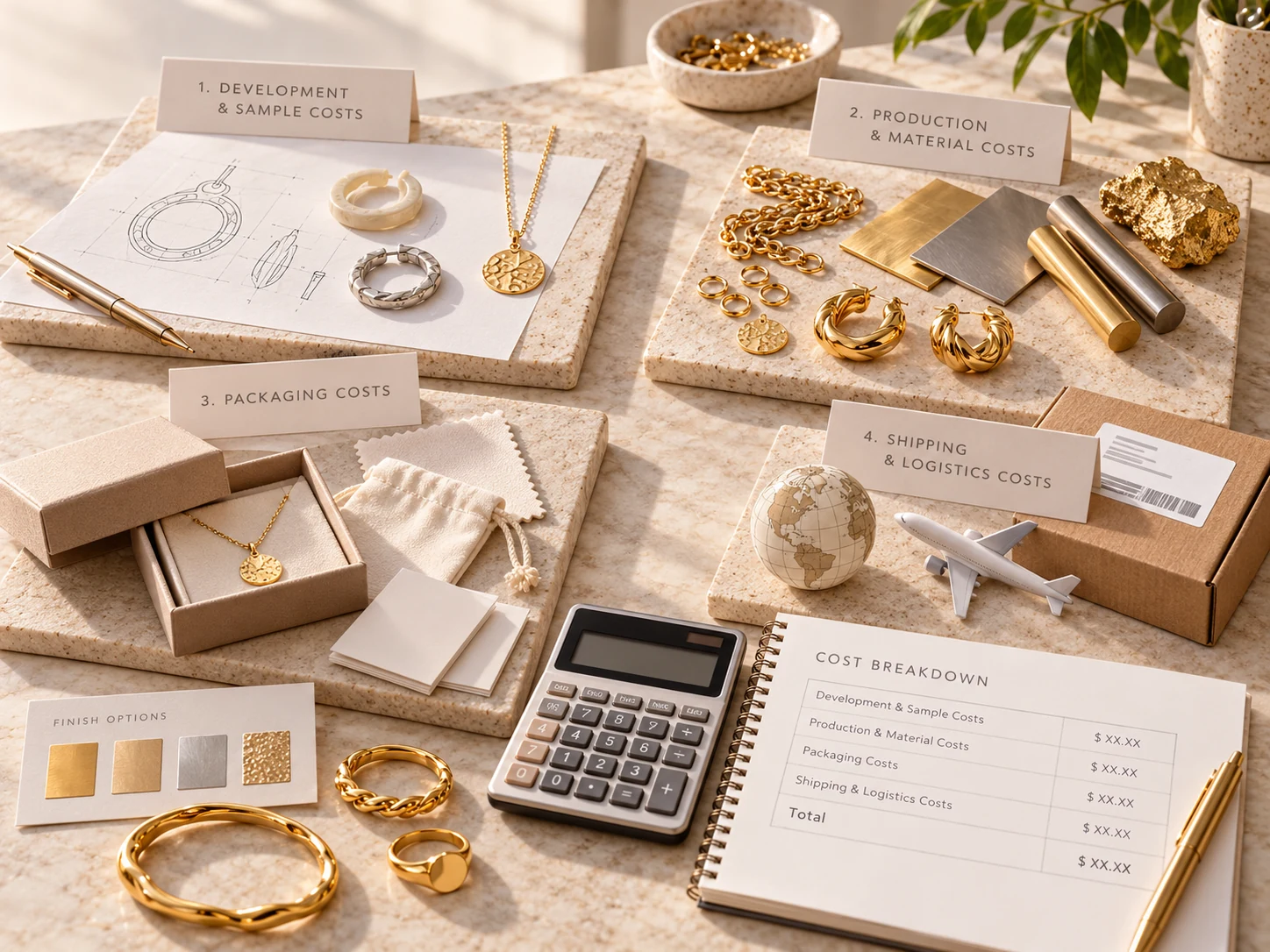
Do not add a fee twice. One factory may bundle basic finishing and standard packing into its unit price; another may show them as separate lines. Neither format is necessarily wrong. What matters is the scope behind the number.
For a collection with several designs, the first-order cash commitment and the effective cost per accepted unit are often more informative than the cheapest quoted unit price.
Why MOQ Can Make an Affordable Jewelry Design Expensive to Launch
Minimum order quantity is a production constraint, not necessarily a minimum for your entire collection. Depending on the manufacturer and the design, a minimum can be applied per style, color, plating finish, size, or component specification. Those variations may need separate production setups or material commitments.
That creates a specific risk for a new brand: adding more designs or ring sizes can multiply the first order before any product has been sold.
Calculate the real number of units—not just the headline MOQ
Illustrative assortment only: suppose a proposed collection has three ring designs, three sizes per design, and a manufacturer requires 50 units for each size of each design. The initial quantity would be:
3 designs × 3 sizes × 50 units = 450 rings.
If the same manufacturer instead allows sizes to be mixed within a 50-unit minimum per design, the proposed minimum would be only 3 × 50 = 150 rings. That is a difference of 300 units before you even compare metal or plating prices.
These are alternative hypothetical MOQ arrangements, not HaoLustra policies or offers. The key is to have the factory confirm how it counts every variant in writing. More finishes, packaging versions, or original components can change the calculation again.
Before requesting a quote, build a small assortment sheet with these columns:
| Field | Example to record |
|---|---|
| Design / style | Ring A, Ring B, Pendant C |
| Size | S / M / L, or dimensions of each variation |
| Finish / color | Gold-tone, silver-tone, or another specified finish |
| Requested quantity | Number of pieces, pairs, or complete sets, clearly labeled |
| Supplier MOQ basis | Per style? Per size? Per finish? Can variations be combined? |
| Forecast / reorder plan | Which variations will you test first? |
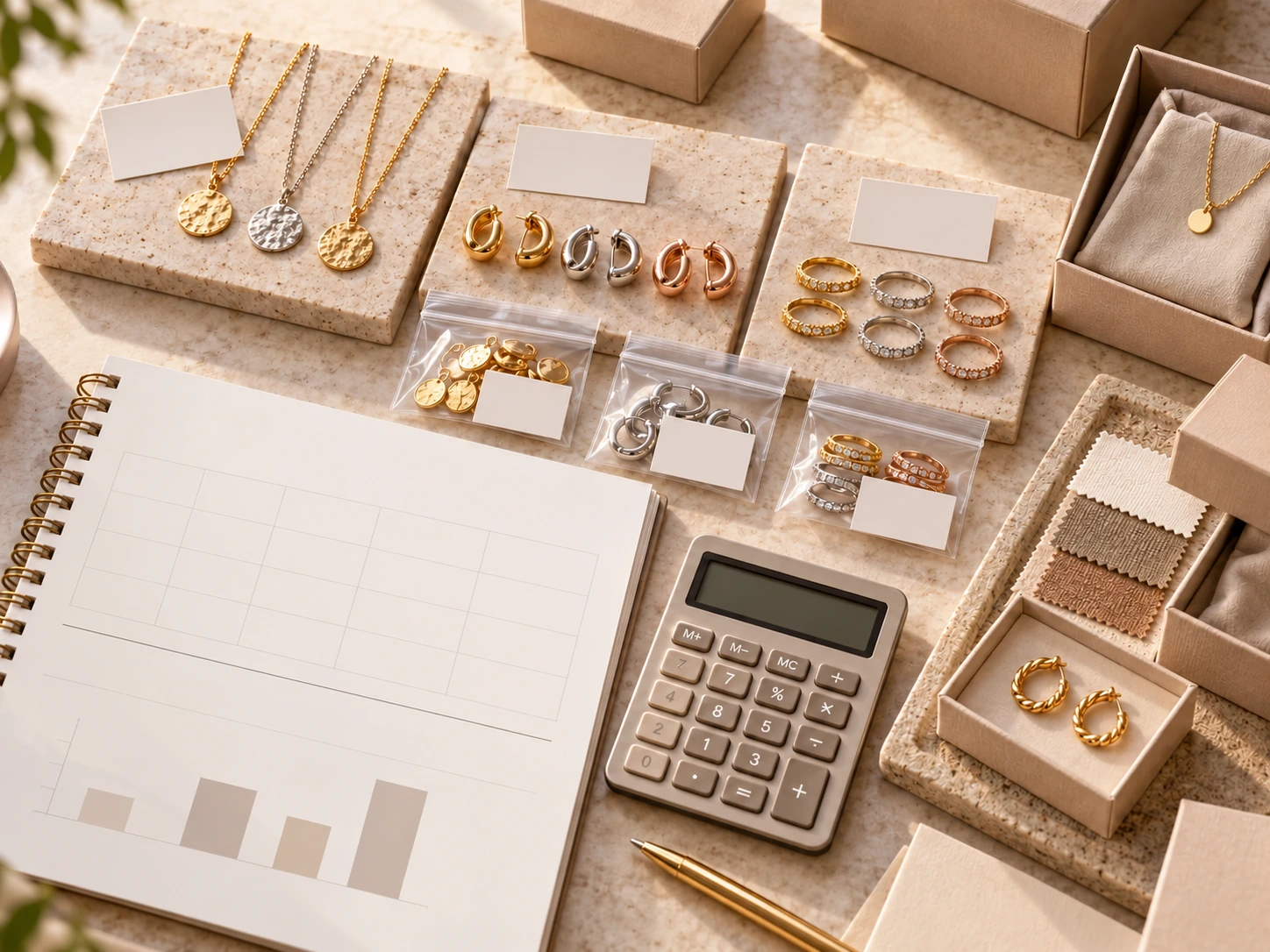
A necklace, pair of earrings, and bracelet sold as one customer-facing set may still be three different manufacturing items. Do not assume that a quoted minimum of 50 means 50 complete sets. Ask whether the factory quotes the individual items, assembled sets, or both.
At HaoLustra, around 50 pieces per style is a working reference for many standard projects, not a universal rule. The minimum can depend on design, material, finish, packaging, and production requirements; some smaller test quantities may be reviewed case by case. For a collection with many variations, explore low MOQ jewelry manufacturing options before treating an initial price list as the final production plan.
Lower total commitment can matter more than lower unit price
A larger order may sometimes achieve a lower per-unit quote because setup and material procurement are spread over more pieces. It also ties up more cash in inventory that the brand has not yet validated. A smaller first run can be a sensible choice even when the unit price is higher—provided the product and manufacturing method allow it.
The question is not simply “What is your lowest piece price?” It is “What is the smallest practical, correctly specified launch that my budget can support?”
One-Time Costs: Design, CAD, Tooling, and Samples
One-time costs depend on how much original development a piece requires. A reference photo can communicate the visual idea, but it usually does not establish exact dimensions, weight, clasp construction, stone settings, surface finish, or production tolerances.
Design review and CAD
A new design may need technical clarification, a drawing, or a CAD model. Some projects begin with an existing sample or usable CAD file; others require additional interpretation and engineering. Ask whether the fee is per style, per component, per revision, or part of a combined development package.
CAD pricing discussed by individual designers online varies, but an anecdotal quote is not an industry price benchmark. HaoLustra does not publish a universal CAD rate. The development work is assessed against the actual project.
Molds, tooling, and new components
A custom casting, stamping, or other production process may require tooling. An adapted existing component may not need the same setup. Before paying, ask exactly what will be created, whether it can be reused, when design changes require a replacement tool, and what the contract says about retention and ownership.
Do not assume all jewelry uses the same mold process, or that tooling paid for once automatically becomes your property.
Physical samples, revisions, and approval
The sample quotation may cover making a physical piece plus selected development, finishing, or checking work. A larger change to design geometry, material, or finish can create further sample costs. Confirm the scope of revisions, sample shipping, and the point at which the final sample is approved.
For qualifying HaoLustra projects, a sample development fee may be credited against a later production order under the agreed terms. That is not a general promise of free samples, refunds, or a standard credit amount. See the separate sampling questions for small jewelry businesses for a more detailed approval checklist.
What Determines the Production Price per Piece?
Even if two pieces look similar in a product photo, their cost can differ significantly once the specifications are documented.
Need help preparing your first jewelry sample?
Share your product idea, target quantity, material preference, and packaging needs. Our team can help you review sampling options before bulk production.
Base material, weight, and purchased parts
The metal and its specified grade, item weight, expected material use, chain, clasp, findings, stones, pearls, and purchased components all affect production. A similar design in stainless steel, brass, or silver should not be assumed to share a cost or production route.
A material substitution should be checked for manufacturing feasibility, finish compatibility, construction, customer expectations, and the market where the finished product will be sold—not treated as a guaranteed saving.
Production method and construction complexity
Casting, machining, stamping, joining, polishing, setting stones, assembling chains, and hand-finishing involve different operations. Complex geometry, more components, delicate connections, or tighter specifications may increase handling and inspection work.
Plating and finish must be specified, not just named
“Gold-tone” is a visual description, not a complete plating specification. For quote comparison, ask which base material, finish method, target appearance, applicable thickness or performance requirement, and quality check each supplier has assumed.
A price difference can reflect a different specification rather than a higher margin. Do not assume a thicker coating, a particular PVD process, or a durability claim without relevant project-specific information. Statements such as never tarnish, waterproof, or hypoallergenic require substantiation and should not be used as automatic product guarantees.
Packaging, branding, and inspection
A logo on a jewelry tag, a printed backing card, a branded pouch, and a rigid box are separate choices. They can involve different materials, print methods, artwork setup, assembly labor, and minimum order quantities. Check what standard packaging is included before adding custom jewelry packaging.
Agree in advance on appearance, dimensions, plating consistency, packaging checks, and any project-specific inspections. Third-party laboratory testing, certification, or import-market documentation should be requested explicitly if applicable; it is not automatically included in a standard production price.
A Worked Example: First-Order Budget Versus Unit Price
All USD amounts below are invented for arithmetic illustration only. They are not HaoLustra prices, market averages, or a supplier quotation. Assume one design, one finish, standard units with no rejected items, and a separately charged development/sample package.
| Hypothetical line item | 60 units | 200 units |
|---|---|---|
| One-time development and sample work | $320.00 | $320.00 |
| Hypothetical manufacturing price per unit | $6.00 | $4.80 |
| Manufacturing subtotal | $360.00 | $960.00 |
| Hypothetical packing cost: $0.75 per unit | $45.00 | $150.00 |
| First-order subtotal | $725.00 | $1,430.00 |
| Subtotal per ordered unit | $12.08 | $7.15 |
Here, the larger order has the lower calculated subtotal per unit but requires $705 more cash before freight, taxes, or other charges. If demand is uncertain, the brand needs to evaluate the risk of unsold inventory as well as the nominal price advantage. A larger quantity does not always secure a lower quote; these figures simply show how to compare alternatives.
The example excludes freight, insurance, import charges, inspection services not quoted above, additional sample rounds, and any rejected units. It assumes the hypothetical packaging fee is not already included in the manufacturing price.
For a real project, use the following calculations:
First-order project budget = agreed one-time development charges + Σ (quoted unit price for each SKU × units for that SKU) + separately quoted packaging / inspection / assembly charges + applicable delivery and import expenses − expressly agreed credits.
Effective acquisition cost per accepted saleable unit = actual total acquisition spending ÷ the number of accepted saleable units.
Record the quote currency, any applicable currency-conversion cost, and the date of pricing separately. Your actual selling price and gross margin are different calculations; this guide focuses on the cost of acquiring inventory.
OEM, ODM, and Private Label: How the Development Route Changes Cost
The words OEM, ODM, and private label do not establish a fixed pricing tier. They describe different starting points and work scopes.
| Development route | Starting point | Costs to clarify |
|---|---|---|
| OEM / original design | Your sketch, approved sample, drawings, or CAD | Technical interpretation, unique components, tooling, samples, and production |
| ODM / adapted direction | An available product or design direction with agreed changes | Which details are reused, what requires new development, samples, and branding |
| Private label program | Ready, adapted, or original products sold under your brand | Logo method, labels, cards, boxes, packing labor, and production minimums |
A fully original design can require more development than adjusting a feasible existing product, but not every adaptation is simple. Materials, complexity, and branding requirements still determine the quote. Read about HaoLustra’s private label jewelry programs or custom jewelry manufacturing to choose a route that fits the product itself.
Factory Price Is Not the Same as Landed Cost
The number on a manufacturer’s production quote may not be the amount you ultimately pay to receive products in your warehouse. Additional charges can include sample shipping, freight, insurance, clearance, import duties, applicable taxes, delivery to your fulfillment provider, and receiving or repacking work.
The agreed delivery term and named place determine which obligations sit with the buyer and seller. The International Chamber of Commerce’s Incoterms® 2020 guidance explains the framework for allocating transport-related responsibilities. Incoterms do not replace your commercial agreement or automatically calculate local duties and taxes.
When requesting quotes, ask: Is the number ex-factory or delivered? Which costs are included? Who arranges transport and customs clearance? Which party pays the applicable import charges under the contract? The answers matter more than comparing two bare unit prices.
How to Compare Two Jewelry Manufacturing Quotes Fairly
Instead of comparing a $4 quote and a $5 quote in isolation, align the scope first. Use this checklist when reviewing suppliers:
| Compare on the same basis | Confirm in writing |
|---|---|
| Product definition | Drawing / sample reference, dimensions, components, weight assumptions |
| Material | Base metal and specified grade where relevant |
| Surface finish | Method, appearance, plating / coating specification and agreed checks |
| MOQ and units | Quantity per design, size, color, pair, set, and packaging variant |
| Development | CAD, molds, sample scope, revisions, credits, tooling reuse terms |
| Unit price | Quantity tier, currency, included processes, included standard packing |
| Branding / packing | Logo application, cards / boxes, packing and separate MOQ |
| Quality and evidence | Approved sample, acceptance criteria, inspections, tests if requested |
| Shipping / destination | Delivery term, named place, freight, taxes / duties assumptions |
| Reorder terms | Confirmed repeat specifications, tooling availability, future minimums |
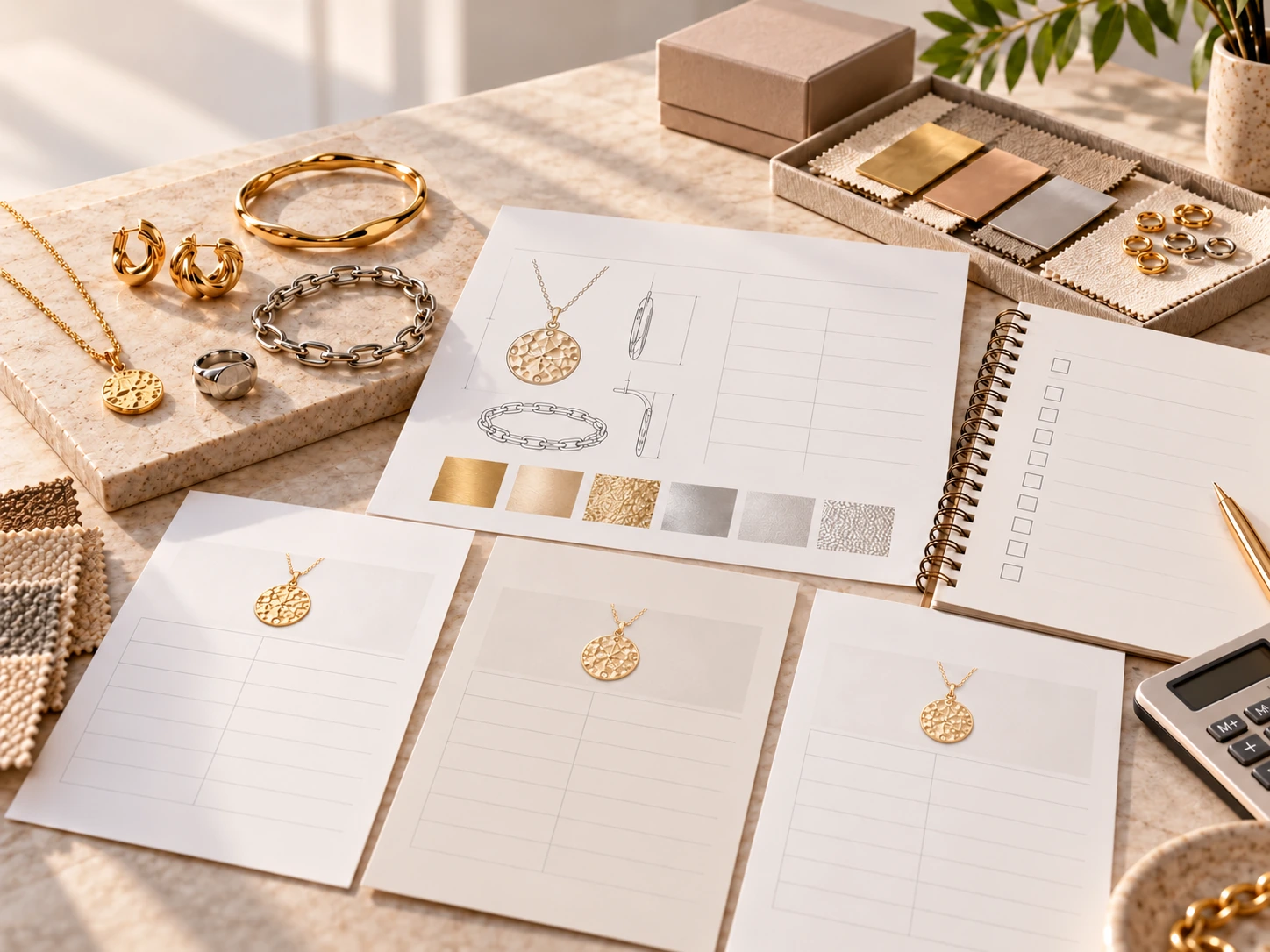
If important specifications are missing, request a revised like-for-like quote rather than assuming the offers are equivalent. If your main concern is how to choose a reliable supplier, use the separate manufacturer selection guide rather than treating this cost article as a complete supplier audit.
How to Keep a First Jewelry Collection Within Budget
Start with a tighter assortment. Fewer designs, finishes, and sizes can reduce the number of separate minimums, but only if they still fit your customer demand and the supplier’s actual rules.
Provide a clear product brief. Specify size, material, finish, components, branding, and quantity by SKU before asking factories to compare prices. Clear inputs reduce scope ambiguity; they do not eliminate sample revisions.
Separate must-haves from optional upgrades. Prioritize quality- or compliance-critical specifications, then ask which nonessential aesthetic or packaging choices have cost alternatives. Never lower an essential specification only to obtain a cheaper quote.
Review adapted product routes where suitable. If exclusive tooling is not required for the business concept, assess whether an approved existing or adaptable product direction could meet the brand’s needs.
Compare the minimum viable launch—not just the maximum discount tier. A smaller order may protect cash for photography, marketing, and replenishment. A larger order may make sense when demand and specifications are well established.
Document reorders from the beginning. Keep approved measurements, finish, components, packaging, and commercial terms together. Ask which tools or development assets can be reused; do not assume every reorder avoids setup fees.
What to Send HaoLustra for a Project-Specific Jewelry Quote
HaoLustra operates a jewelry factory in Qingdao, China and supports B2B jewelry development, OEM/ODM project review, sampling, production, private label packaging coordination, and agreed quality checks. The final cost and workable production route depend on the actual brief; HaoLustra does not publish a single universal price list for all custom designs.
You can start with imperfect specifications. Share as much of the following as you know:
- Product categories, number of styles, and authorized sketches / references / CAD or samples;
- Approximate dimensions, construction, preferred material, and acceptable alternatives;
- Finish and plating direction, decorative components, and any required technical specifications;
- Expected units by style, size, finish, and color, with pairs or sets labeled clearly;
- Logo placement and packaging choices, plus target packaging quantities;
- Target market, receiving country or destination, and delivery basis if known;
- Required sampling, approvals, quality checks, and target launch period.
We can review the specifications to discuss a workable sampling and production plan. A published cost guide is not a binding quotation. Request a project-specific manufacturing quote with your product details.
Jewelry Manufacturing Cost FAQs
How much does it cost to manufacture jewelry in bulk?
There is no dependable universal unit price for all jewelry. A realistic quote depends on the design, material, weight, finish, components, order quantity per variation, development work, packaging, and delivery terms. Compare your total first-order commitment as well as the factory price per piece.
Does MOQ apply per design, size, color, or total order?
It depends on the design and supplier’s production setup. MOQ may be applied separately by style, size, finish, or other variation. Have the factory provide a written SKU-by-SKU quantity schedule. HaoLustra’s approximate 50-pieces-per-style reference for many standard projects is not a universal minimum or an automatic mixed-style allowance.
Are CAD, mold, and sample fees included in jewelry unit prices?
They may be bundled or quoted separately. Ask whether development fees are one-time, which changes trigger additional charges, what is included in sample revisions, and whether tooling can be reused under the agreement. Do not assume that every design requires tooling or that all fees are refundable.
Can a HaoLustra sample development fee be credited toward production?
For selected qualifying projects, a sample development fee may be credited against a later production order according to the agreed project terms. Eligibility and amount are confirmed in the individual quotation; this is not a universal promise of a free or refundable sample.
Why do two manufacturers quote different prices for a similar jewelry design?
Their assumptions may differ in base material, weight, dimensions, plating, purchased components, assembly, quality checks, packaging, quantity, or shipping terms. Request matching specifications and a written list of inclusions and exclusions before comparing the prices.
Is a 50-piece MOQ for a jewelry set 50 complete sets?
Not automatically. An earring pair, necklace, and bracelet may be counted as separate manufacturing items, or a factory may quote an agreed assembled set program. The unit definition and minimum quantity must be confirmed for each product and variation before paying development costs.
Does custom jewelry packaging require a separate minimum order?
It can. Printed cards, pouches, labels, and boxes may have their own artwork, materials, supplier minimums, and packing charges. Ask which standard packing is already included and whether branded packaging requires a separate quantity or setup fee.
How do I estimate landed jewelry manufacturing cost per piece?
Add all applicable development, production, packaging, agreed inspection, delivery, and import expenses, avoid double-counting items already included in unit prices, subtract only confirmed credits, and divide actual acquisition spending by accepted saleable units. Check the named delivery term and destination before comparing quotations.
Editorial disclosure: All worked USD figures and MOQ calculation arrangements in this article are hypothetical teaching examples, not HaoLustra quotations or verified market price benchmarks. Project costs, material options, minimum quantities, development fees, sample credits, and delivery obligations must be confirmed in writing for the actual order.
Plan Your First Sample with HaoLustra
Tell us what you want to make, your target quantity, and your packaging needs. We will help you review a practical path from sample to production.