Custom Bangle Manufacturer for Jewelry Brands
Turn your bangle design into a clear production specification—with feasibility review, sampling, material and finish planning, and project-based bulk manufacturing support.

Start with a manufacturable brief
A reference photo alone cannot define inner size, structure, coating, or tooling needs. HaoLustra can review designs, sketches, CAD files, or samples to clarify requirements before quoting.
The first review should distinguish what is already decided from what still requires design development. For a closed bangle, that might be the cross-section, inner diameter and size range; for a hinged style, it may also include the closure layout and assembly method. Clarifying those points early helps a sourcing team avoid comparing quotations based on different assumptions.
For chain and beaded designs, see our custom bracelet manufacturing service.
Design reference
Sketch, drawing, CAD or sample.
Construction
Closed, open, hinged or stacked.
Key specification
Inner size, thickness, finish and logo.
Buyer plan
Quantity by size and finish; destination.
Buyer note · What counts as a complete manufacturing brief?
Provide the available reference image, technical drawing or existing sample together with target market, intended materials, preferred finish, branding and estimated quantities. If you do not know a dimension or construction detail, mark it as an open item instead of copying a measurement from another product. HaoLustra can use that starting information to discuss feasibility and identify which details require drawings, samples or supplier confirmation before an accurate production quotation.
Choose the bangle construction
Four common design directions. Structure affects tooling, measurements, sample checks and cost. Final feasibility is assessed per design.
Closed Bangle
Internal dimensions and hand-pass fit.
Open Bangle / Cuff
Opening, edge details and intended adjustment.
Hinged Bangle
Hinge alignment and closure verification.
Stackable Bangles
Size, finish and collection consistency.
Illustrations explain shapes only; they do not establish HaoLustra factory capability for every construction.
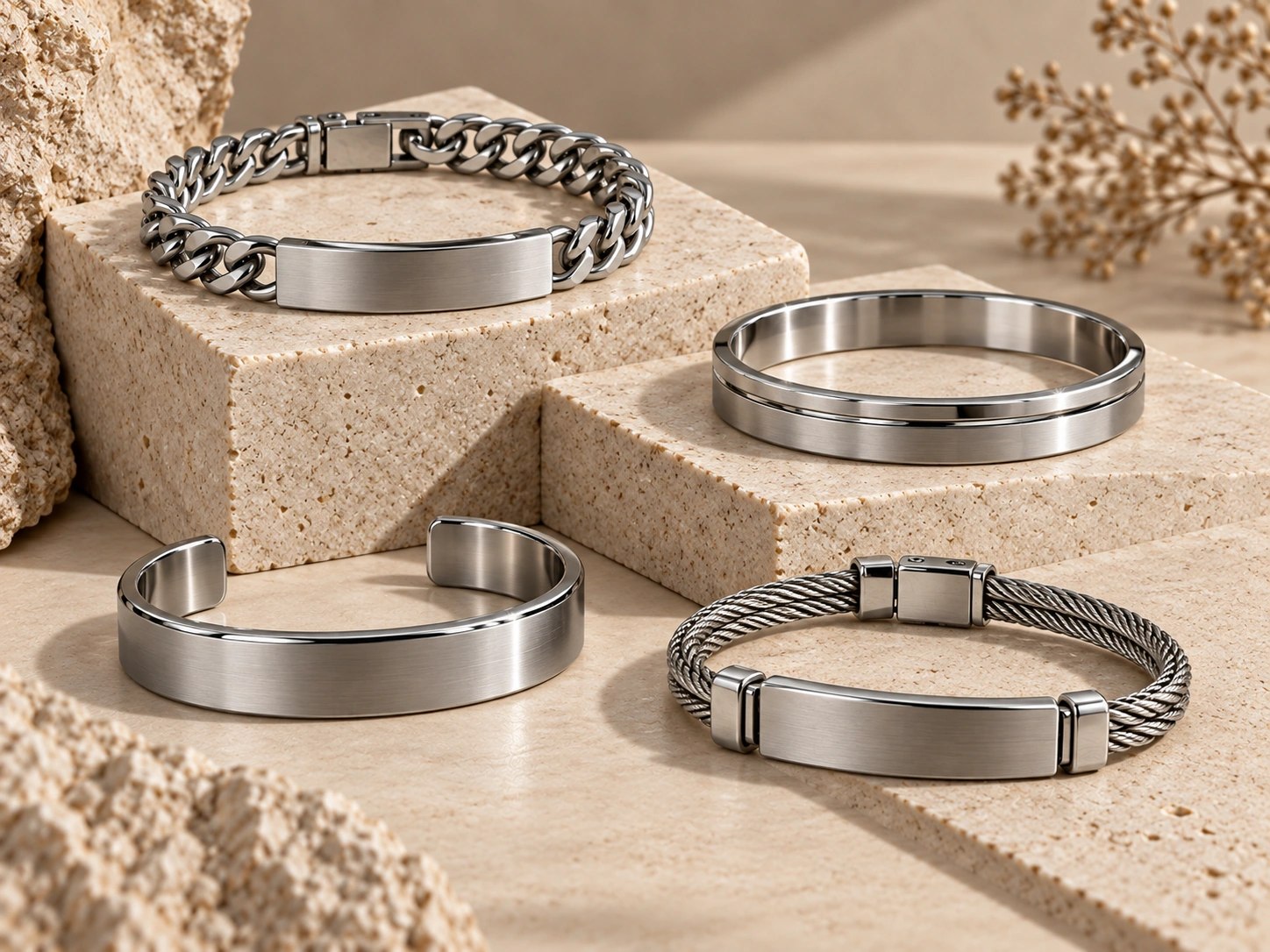
Six decisions to settle before placing a PO
Focus on information that changes your development budget, sample schedule or bulk-order confidence.
Review construction and dimensions before tooling.
Separate CAD, molds, samples and unit pricing.
Confirm quantities by size, finish and design.
Lock drawing, finish, logo and sample version.
Agree on measurable size and appearance criteria.
Keep the approved spec and packaging reference.
A simpler route from design to production
A documented sample-to-bulk process helps buyers avoid disagreements over dimensions, finish, and approvals.
Treat each development stage as an approval checkpoint rather than an automatic promise of timing. The buyer should know which drawing is under review, whether a physical sample is needed, and which dimensions or finish details will be checked. If artwork, closure geometry or material changes after approval, ask whether revised sampling, tooling or pricing is required before moving to bulk production.
Dimension drawing is schematic, not a certified CAD drawing or customer project.
Share your design
Send a sketch, CAD file or existing sample.
Confirm feasibility
Review structure, size and materials.
Develop and review sample
Check the proposed finish and key details.
Approve the production standard
Record size, finish, branding and version.
Confirm bulk & QC
Finalize quantity, acceptance points and packaging.
Make your quotation easier to compare
A low unit price does not describe the full development cost. Ask suppliers to show what is included—and what is quoted separately.
Ask for the estimated unit quantity by design, size and finish—not only the combined number of bangles in a collection. Where a project requires CAD work, a new mold, custom assembly or dedicated plating setup, those items may affect the budget differently from manufacturing an existing structure. A supplier should clarify whether they are included in the unit price or billed separately.
MOQ is project-specific. Around 50 pcs per style is a general reference for many standard HaoLustra projects, not a fixed minimum for custom bangles.
Design / CAD review
Artwork refinement or modeling, if required.
Tooling or molds
Construction-dependent development costs.
Sample + revisions
Confirm versions, fees and revision scope.
Production + packaging
Unit prices, quantities, finish and brand pack-out.
Any sample-fee credit or tooling offset requires written project agreement.
Quote review · Questions worth asking
Is the MOQ applied per design, per size, per color, or per tooling family? Are samples and revisions priced separately? Does the quotation include surface treatment, engraving, packing materials, inspection and freight? If a sample fee or development charge might be credited later, ask for the written conditions. HaoLustra’s general reference of around 50 pieces per style is not a guaranteed minimum for all custom bangles; an actual MOQ must follow the design and approved quotation.
Approve one shared product standard
Record the approved design, dimensions, material and appearance reference before production. This becomes the basis for inspecting bulk pieces and managing reorders.
The approved specification should name the exact measurement points and the way the supplier will compare samples with bulk pieces. It can include inner dimensions, width, thickness, opening gap or closure geometry, material requirements, surface finish, logo placement and packing instructions. Avoid relying on terms such as “same as photo” when a measurable detail affects the result.
A well-designed bangle also considers safe edge treatment and practical fit. These are sample-stage checks—not consumer-marketing claims.
Specification control · Materials, coatings and changes
For stainless steel or brass bangles, confirm the requested base material and surface-treatment direction before production. If a specific grade, coating thickness, nickel-release limit or performance claim matters to the target market, agree on the evidence or testing required for that order. Do not infer “waterproof,” “hypoallergenic” or permanent color retention from material names alone. Keep any approved design or finish change attached to the current sample version and quotation.
Plan bangle materials, finishes and logo details together
Material choice should be assessed alongside the intended shape, the requested appearance and the expected use of the finished product. Stainless steel and brass may call for different production and surface-treatment approaches; availability depends on the design and confirmed supply route.
When a jewelry brand requests gold-tone, silver-tone, rose-gold-tone or another finish, the quotation should identify the proposed treatment and an appearance reference. Engraving on the inside or outside of a curved bangle needs artwork size, direction and placement approval. Branding can extend to jewelry cards, pouches, labels or boxes, but each customization may have its own minimum and preparation requirements.
Explore broader custom packaging options after the product specification is confirmed.
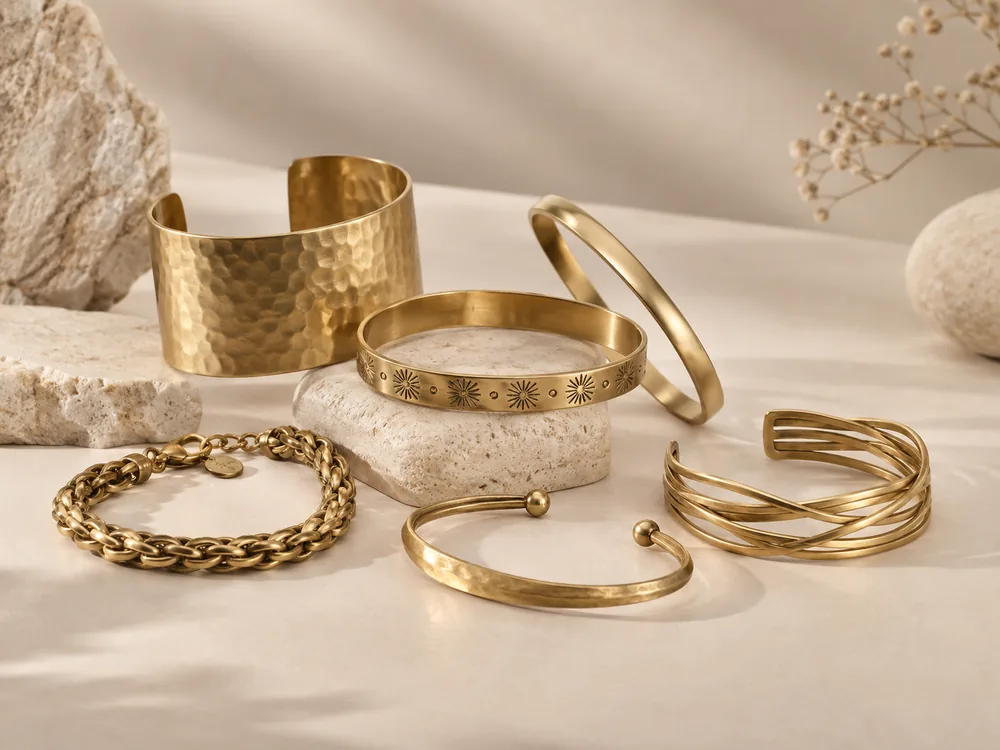
Inspect the details that affect bulk acceptance
Agree on a reference sample, measurement method and acceptance criteria—rather than relying only on the phrase “strict QC.”
A bangle-specific inspection plan can cover size coding, internal shape, finish color, engraving location and the appearance of visible edges. A hinged design may also require closure alignment and agreed functional checks; an open cuff needs its opening and end shape checked against the approved sample. Exact tolerances and inspection methods should be agreed per order, not invented as a universal factory standard.
Internal size, shape and tolerances
Hinge, opening and edge treatment
Surface finish, color and engraving
Labels, inserts and protective packing
See HaoLustra quality control for broader inspection information.
Inspection illustration only. Actual tolerances and testing are agreed for each order.
Quality plan · Sample-to-bulk verification
Ask how the accepted sample will be identified, what measurement tools or visual references will be used, and how deviations will be reported. For branded products, packaging and labeling belong in the same approval process as the jewelry. A bangle that is dimensionally correct but arrives with scuffed plating or the wrong logo orientation can still be a sourcing problem. The buyer and supplier should document relevant acceptance criteria before production starts.
Make multi-SKU bangle collections easier to reorder
For brands developing several custom bangle styles, a single hero sample is not enough to define the whole collection. Each size, finish, logo variant and construction needs a clear reference so purchasing teams know which items can be made together and which require separate approval.
Keep an agreed style-and-variation register linked to the approved sample and packaging. On a future order, confirm that the material source, proposed finish, construction and relevant components still match the original requirement. If any part changes, document the revised specification and decide whether a new sample is necessary before replenishment. This supports more reliable communication without promising identical results in every uncontrolled production condition.
HaoLustra supports your brand beyond the sample
Based in Qingdao, China, HaoLustra works with jewelry brands, retailers, wholesalers and sourcing teams on OEM/ODM project review, sample development, production planning, quality checks and private-label packaging.
Final construction methods, lead time, cost and production capacity are confirmed for the specific design.

Request a custom bangle quote
Send your reference and what you know. We’ll identify the specifications needed to evaluate sampling and production.
Custom bangle manufacturing FAQ
Answers to common procurement questions. Final conditions are agreed for the individual design.
Can HaoLustra develop custom bangles from my design or sample?
Yes, you can submit a sketch, CAD file, reference image or existing sample for a project review. HaoLustra can discuss production feasibility, required specifications and sampling options. The final manufacturing route depends on the design.
What is the difference between a closed bangle and a cuff bracelet for manufacturing?
A closed bangle is a continuous rigid ring, so its inner size and ability to pass over the hand matter. An open cuff has an opening and needs a defined gap, profile and edge treatment. For either structure, confirm dimensions and appearance on a physical sample before production approval.
Can a custom hinged bangle be produced from a CAD drawing?
Submit the CAD drawing with the intended hinge or closure details for feasibility review. Alignment, components, assembly and any agreed functional test must be considered before a sample and final quotation can be confirmed.
How is the MOQ calculated for custom bangles?
MOQ depends on construction, tooling, materials, finishes, dimensions and variation counts. Around 50 pieces per style is a general working reference for many standard HaoLustra projects, not a blanket bangle minimum. Ask for a written quantity rule for each design, size and finish.
Are CAD, tooling and sample fees included in the unit price?
Not necessarily. Request an itemized quote that identifies any development work, mold or tooling, sample cost, revisions, unit production cost and branded packaging. Credits or offsets should be agreed in writing for the specific project.
What should my purchasing team approve before bulk bangle production?
Confirm the sample version, size specification, relevant opening or closure criteria, material, finish, engraving placement, packaging and agreed inspection points. Record how later revisions will be quoted and approved.
Can we develop different bangle sizes and colors under one collection?
Yes, a collection can be discussed with several proposed variations. Whether the same tooling, sampling route or MOQ applies to all variations depends on their construction and specification. Include quantities by SKU and request confirmation before committing.
Can our logo and private-label packaging be included?
Logo placement and packaging options can be reviewed alongside the design. Supply artwork, intended placement and presentation requirements so sample appearance, label details and protective packing can be assessed together.
How can we keep repeat bangle orders consistent with the approved sample?
Maintain a dated reference with the approved drawing, dimensions, finish, components, logo and packaging. For each reorder, confirm any requested changes and the inspection criteria against that reference rather than assuming the specification has remained unchanged.