CULTURED FRESHWATER & IMITATION PEARL JEWELRY · OEM / ODM
Custom Pearl Jewelry Manufacturer for Brands
HaoLustra is a custom pearl jewelry manufacturer in Qingdao, China, supporting jewelry brands, boutiques, wholesalers and sourcing teams. We develop finished necklaces, earrings, bracelets and coordinated collections using cultured freshwater pearl or imitation pearl components. Our B2B support includes design and material review, pearl-specific sample requirements, production planning and private-label presentation.
Choose your material route before quoting. With cultured freshwater pearls, the approval should define size, shape, color, luster and acceptable natural variation. With imitation pearls, it should define the manufactured component, visible finish and assembly. We do not treat these materials as interchangeable. Exact components, sampling scope, minimum quantities and lead times are confirmed for each project.
Request a Pearl Jewelry Quote Discuss a Sample
Quick guide: Two distinctly specified pearl materials · Written matching criteria · Sample-led approval · Material-specific reorder review
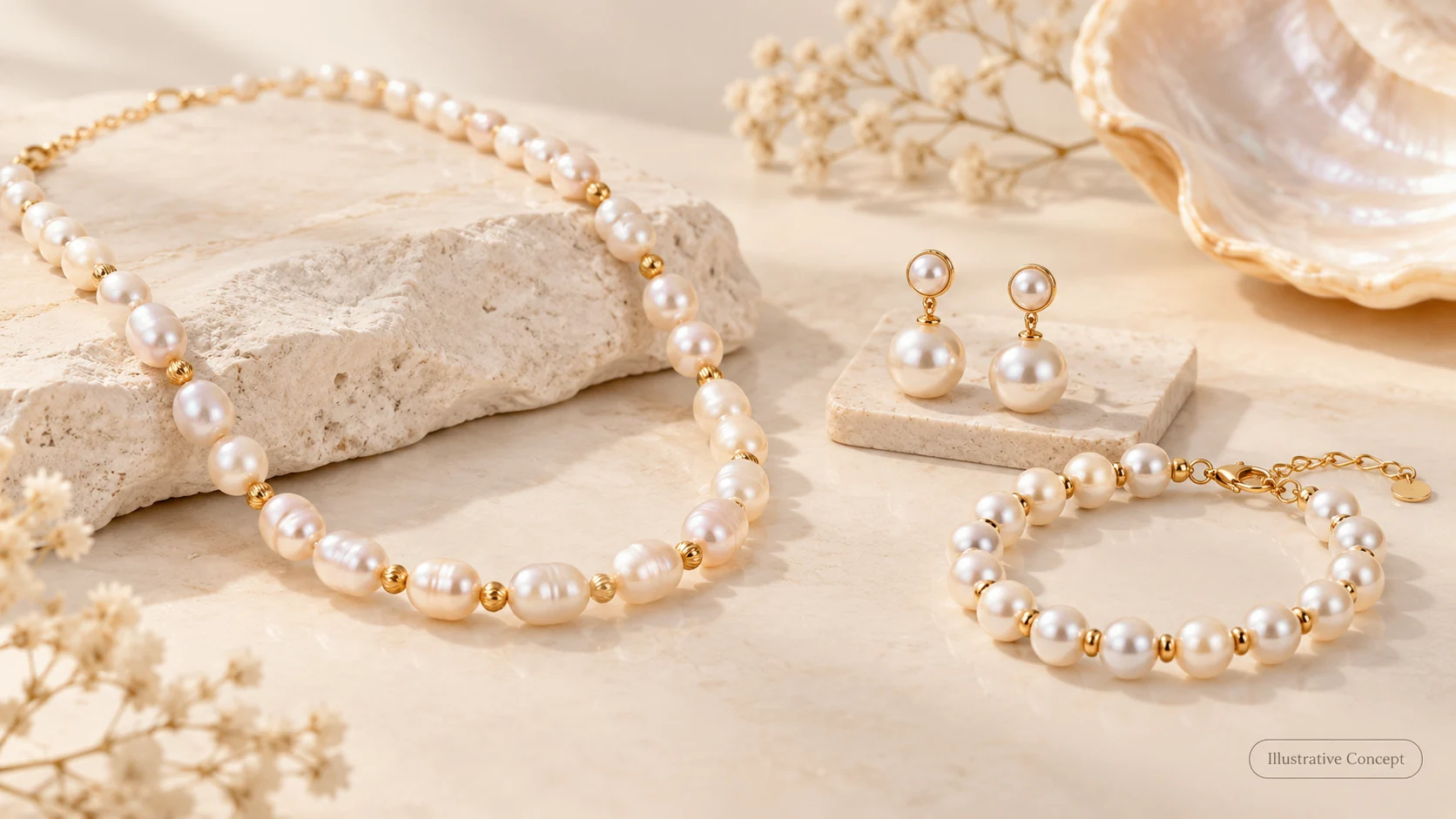
1. Choose Cultured Freshwater or Imitation Pearl Components
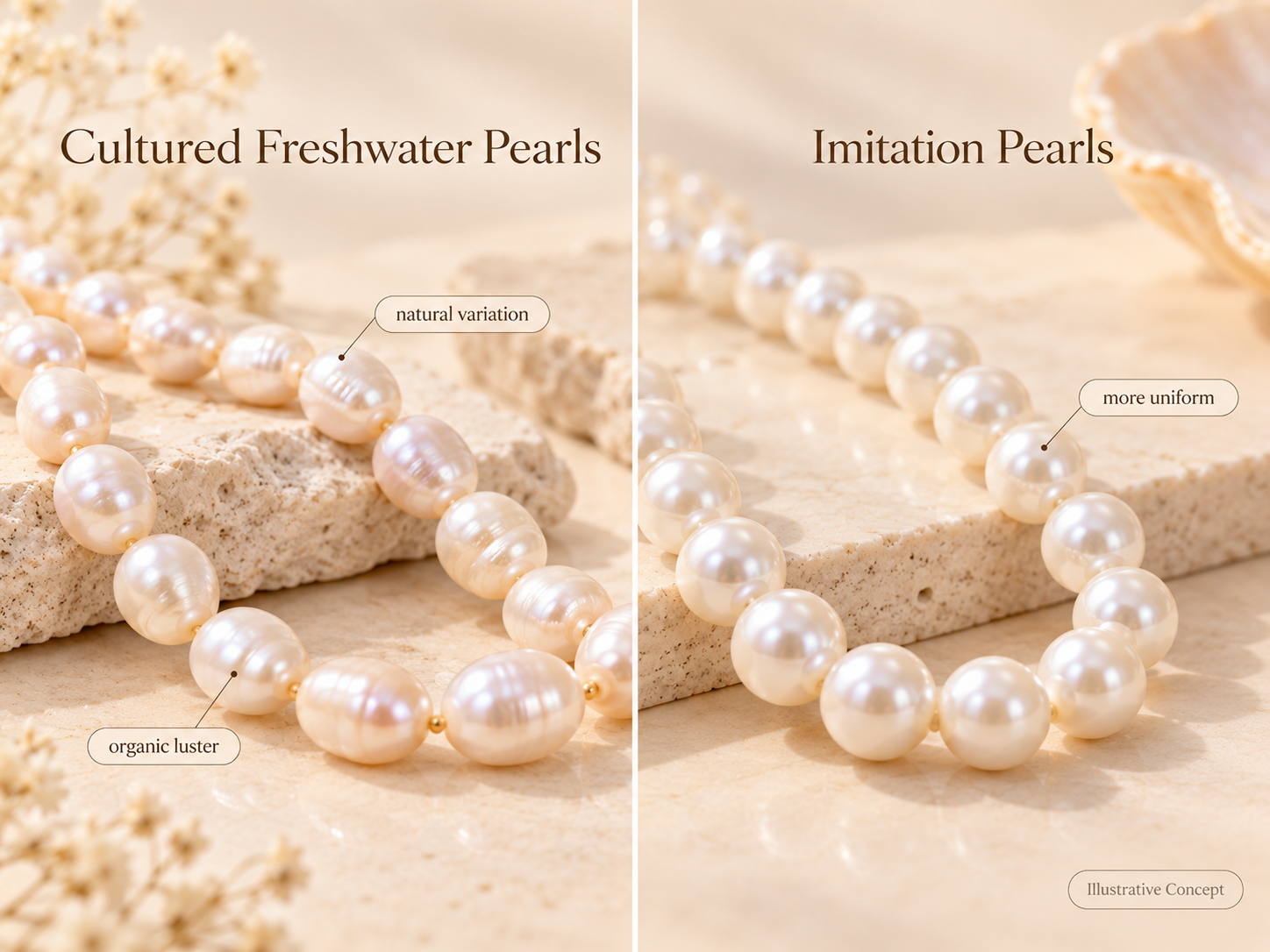
A photograph can show the design direction of a pearl necklace or earring, but it cannot reliably establish the material inside the product. Decide whether the intended collection uses cultured freshwater pearls or imitation pearls, and carry that decision through the quotation, approved sample and final product description.
Cultured freshwater pearl jewelry
Cultured freshwater pearls are produced through cultivation in mollusks. HaoLustra supports finished-jewelry projects using these components. Before sampling, specify the intended pearl size range, shape, color, visible luster, surface appearance and the acceptable relationship between individual pearls. Natural visual differences may be part of the design, but the approved tolerance should not be left to interpretation.
Particular component sizes, supply lots, grades, origins and treatment information require confirmation for the selected project. Finished-jewelry manufacturing is our confirmed scope; pearl farming is not a stated HaoLustra service.
Imitation pearl jewelry
Imitation pearls are manufactured components designed to resemble pearls; they are not cultured pearls. This route can suit a fashion or private-label collection built around a more controlled manufactured look. Confirm the actual component composition, coating or surface finish, dimensions, shade and attachment method from the chosen supplier’s specification. Do not assume all imitation components have the same core or coating material.
For US-facing product descriptions, identify the components as imitation pearls, not simply “pearls.” The marketing shorthand “faux pearls” should not replace the clearer material designation in product specifications or disclosures.
On small screens, scroll the table sideways to view every column.
| Procurement question | Cultured freshwater pearls | Imitation pearls |
|---|---|---|
| What is the component? | Cultured pearl from a mollusk | Manufactured pearl-look component |
| What should be approved? | Size, shape, color, luster, surface and matching tolerances | Composition where confirmed, surface finish, shade, size and attachment |
| What variation matters? | Agreed natural appearance variation and supply-lot differences | Component specifications, coating or finish changes and lot differences |
| What should the buyer-facing description say? | Cultured freshwater pearl jewelry | Imitation pearl jewelry |
Another material? Mother-of-pearl is shell material, not a substitute name for a pearl bead. Treat shell-inlay requests as a separate material specification rather than assuming they belong to either route above.
2. What Pearl Characteristics Must Be Specified?
A request for “premium pearls like the reference photo” is too vague for a repeatable manufacturing brief. For cultured pearls, GIA’s Pearl Quality Factors describe seven evaluation factors: size, shape, color, luster, surface quality, nacre quality and matching. Brands can use these as a framework for the questions they ask suppliers; that does not mean HaoLustra supplies GIA-graded or GIA-certified pearls.
A useful approval sheet records:
- Material identity: cultured freshwater or imitation; supplier’s component reference; any confirmed treatment or composition information.
- Dimensions: requested millimeter range, shape and whether baroque or irregular forms are intentional.
- Visual target: approved color reference and luster/finish expectations, with photographs viewed under agreed lighting.
- Surface acceptance: which visible marks or differences are acceptable, preferably shown in close-up references.
- Matching rule: strict pair matching, intentional asymmetry, uniform strand or deliberate graduation.
- Assembly details: drilling or connection position, stringing direction where applicable, chain, clasp, post and other metal findings.
- Change control: which differences are minor within tolerance and which require a new approval.
For imitation components, use surface coating and finish criteria, not nacre grading. When supplier grading terms are used, ask what their definitions actually cover rather than assuming two vendors’ grades are equivalent.
3. How Should Pearl Earrings and Strands Be Matched?
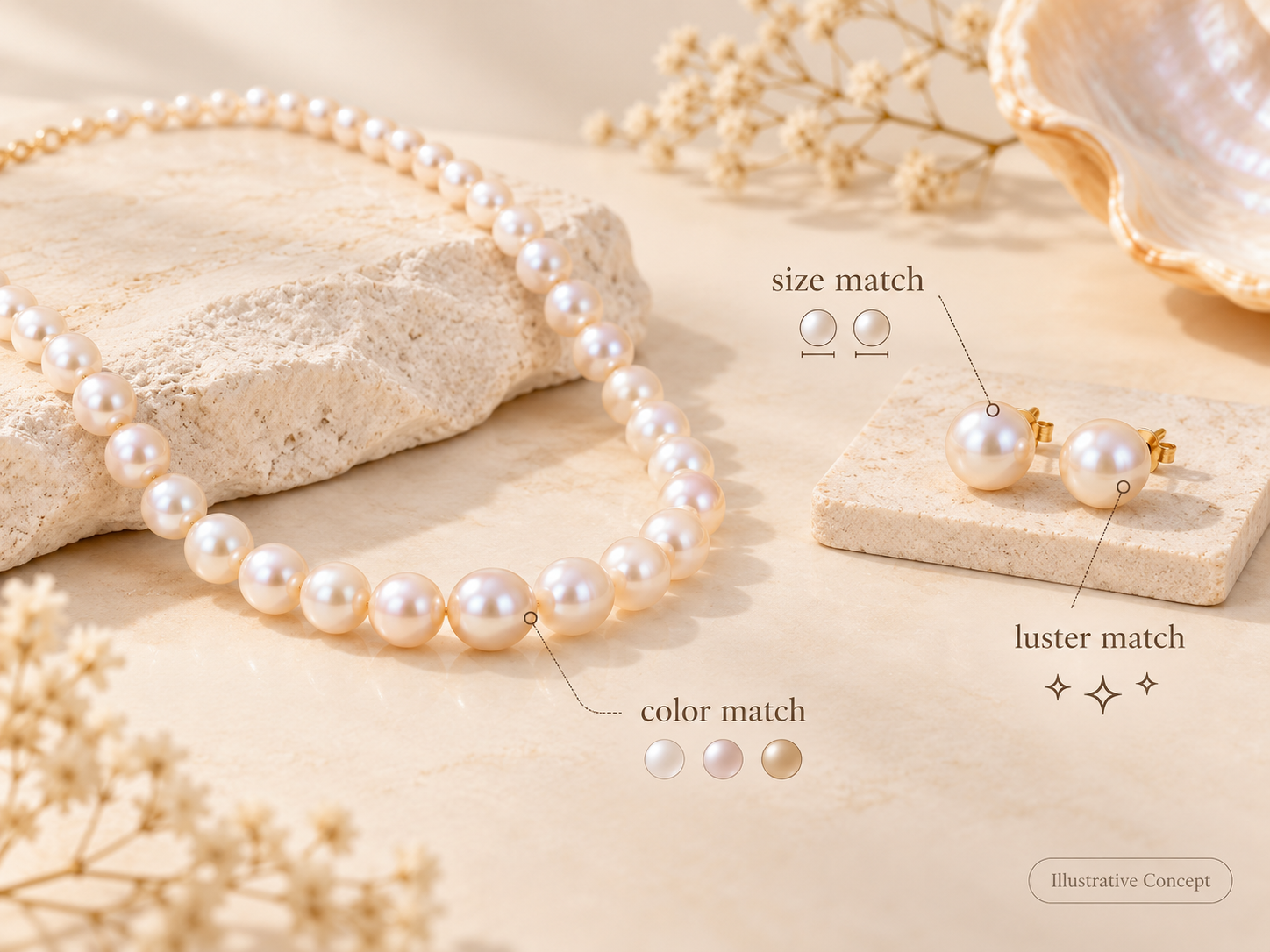
A visually successful pearl collection does not always require identical components. The aim is to agree which differences are intentional and which would be unacceptable in the finished piece.
For a pair of cultured pearl earrings, review the two pearls side by side under consistent lighting. Check relative size, shape, color, visible luster, surface appearance and the orientation of the post or setting. A classic stud design may need a close visual pair; a deliberately asymmetric design needs its own approved reference.
For a strand or spaced necklace, review the intended size sequence, color relationship, component spacing, finished length, position of the clasp and the overall rhythm of the piece. A graduated or baroque-style design can be visually consistent without every pearl looking identical.
For imitation pearls, match the visible surface finish, coating appearance, shade and size against the approved component reference. Pay attention to attachment points and wear-facing surfaces without implying that every available finish has undergone a specific durability test.
These are recommended buyer acceptance criteria. Specialist drilling, stringing, knotting and setting requirements are checked for feasibility at quotation stage; they are not blanket promises of in-house equipment or processing.
For broader category requirements, see custom earrings manufacturing and custom necklace manufacturing.
4. Cultured-Pearl vs Imitation-Pearl QC Checks
The two material routes need different acceptance questions. A cultured pearl should not be rejected for every natural feature if the approved design allows variation. Equally, an imitation component should not be accepted merely because its color resembles the reference when the coating, dimensions or mounting differ from the agreed specification.
On small screens, scroll the table sideways to view every column.
| Review point | Cultured freshwater component | Imitation component |
|---|---|---|
| Identity | Confirm agreed cultured-pearl sourcing information | Confirm specified imitation component and composition information where available |
| Visible appearance | Compare luster, color, surface and shape with approved range | Compare shade, coating/surface finish and dimensions |
| Matching | Verify approved pair/strand relationship | Verify consistency or intentional variation in the design |
| Assembly | Check visible attachment alignment and construction against sample | Check connection and coating-sensitive contact points against sample |
| Records | Note material and lot reference when supplier data is available | Note component/finish reference when supplier data is available |
A brand can use this checklist to agree its sample and bulk-order inspection criteria. It is a proposed inspection framework, not a claim that an undocumented test, third-party certificate or GIA assessment has already been completed by HaoLustra. General inspection processes are described on our jewelry quality control page.
5. From Design Brief to a Pearl-Specific Approved Sample
Material confirmation · Side-by-side appearance · Construction · Acceptable variation · Recorded sign-off
The most useful pearl sample is one that answers a written material question—not simply a piece that looks attractive in a photograph. A sketch or reference image can start the discussion, but approval should identify the pearl route, chosen component, matching expectation and finished assembly.
Before accepting a sample for a proposed bulk order, review:
- Material confirmation: Is the component cultured freshwater or imitation, and has the supplier’s relevant information been checked?
- Side-by-side appearance: Does the pair, strand or selected sample reflect the size, color, shape and finish/luster range agreed for this design?
- Construction: Do the attachments, orientation, length, clasp and metal findings match the approved reference?
- Acceptable variation: What is permissible across individual pearls or subsequent lots? When must a revised sample or new material selection be approved?
- Recorded sign-off: Which sample photographs, component references and notes will be used when reviewing production?
Sampling costs and revision timelines depend on the design and selected materials. Read jewelry sample options for the general sample-before-production process, or OEM/ODM jewelry manufacturing for development routes.
6. What May Change Between Pearl Material Lots?
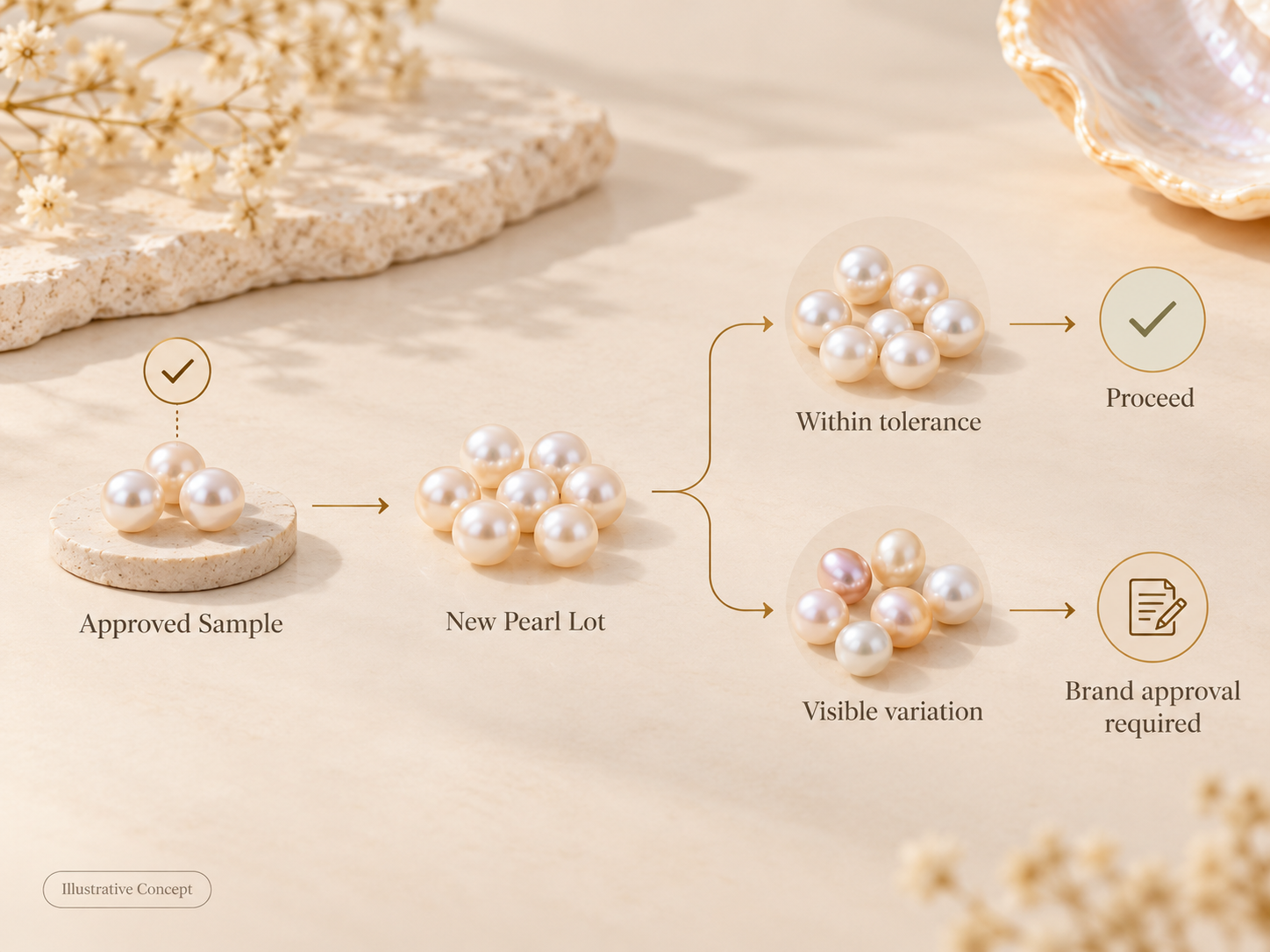
When a brand reorders, the question is not only whether the original design file is unchanged. A new cultured-pearl lot may show differences in shade, luster, shape distribution or available sizes. A manufacturer-selected imitation component may also change its core specification, coating or finish between supplier lots.
For a repeat order, reference the approved sample and written component specification. Ask for review when a proposed replacement changes material identity, visible shade outside the accepted range, pearl size or shape, surface/finish, or the way the component attaches to the jewelry. Depending on the change, the buyer may approve a documented substitution or request a new comparison sample before production is agreed.
No manufacturer should imply that all future pearl lots will be visually identical. Define acceptable variation and the sign-off point instead. For wider production checks, refer to HaoLustra quality control.
7. Pearl Jewelry Options Across a Brand Collection
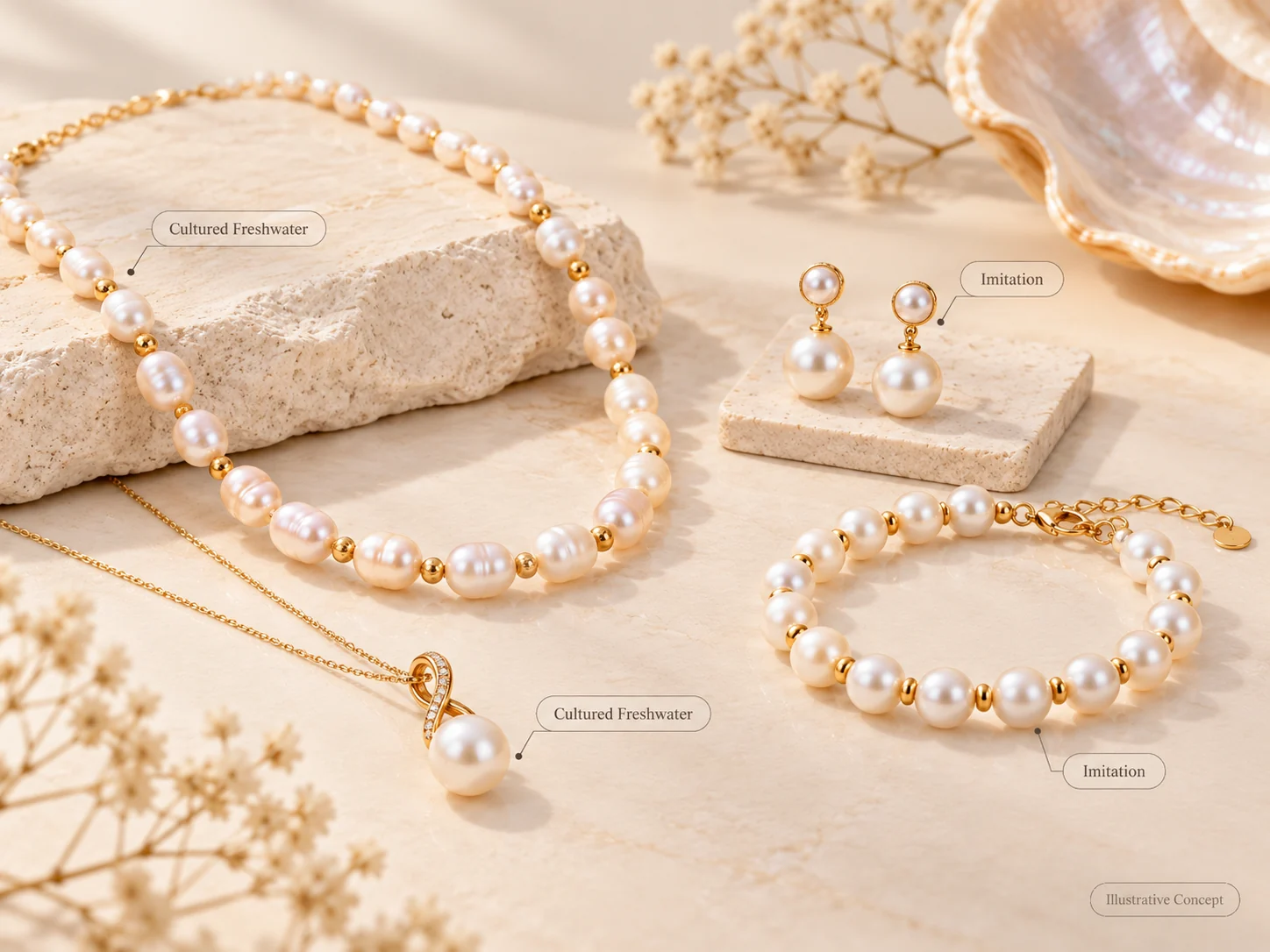
A single pearl material policy can help coordinate designs without forcing every SKU into the same arrangement.
- Necklaces and chokers: pearl spacing, strand graduation, connection methods, length and clasp selection.
- Earrings: close-match pairs, drops, studs or pearl accents where shape and orientation matter.
- Bracelets: visual continuity with the necklace concept, attachment points and overall size.
- Coordinated collections: a consistent cultured-pearl or imitation-pearl identity across multiple styles, including bridal-inspired or boutique assortment concepts.
These are design directions, not a catalog of confirmed stock SKUs or certified pearl grades. Product-specific development, component availability and assembly are quoted by style. Our custom necklace manufacturer, custom earrings manufacturer and custom jewelry sets manufacturer pages cover their respective product structures and set-quantity details.
8. Material-Accurate Private Label Pearl Jewelry
Approved bill of materials → Quotation → Sample record → Product title and description → Printed label or insert
A private-label collection should use the same material identity at every customer-facing touchpoint: approved bill of materials → quotation → sample record → product title and description → printed label or insert. A change from a cultured freshwater pearl component to an imitation component is a material substitution, not a routine cosmetic adjustment.
For cultured freshwater pearls, the description should make their cultured status clear. For imitation pearls, the imitation nature of the component should be stated clearly and consistently. For US-facing sales, the FTC Jewelry Guides should inform material naming, and applicable treatment disclosures should be reviewed when supplier information indicates a treatment; treatment type and whether disclosure is required cannot be inferred from appearance alone.
HaoLustra also supports private-label jewelry manufacturing and custom jewelry packaging. Detailed box formats, logo artwork requirements and packaging MOQ belong to those services; here the priority is getting the pearl material name right.
9. HaoLustra’s Qingdao Pearl Jewelry Manufacturing Support
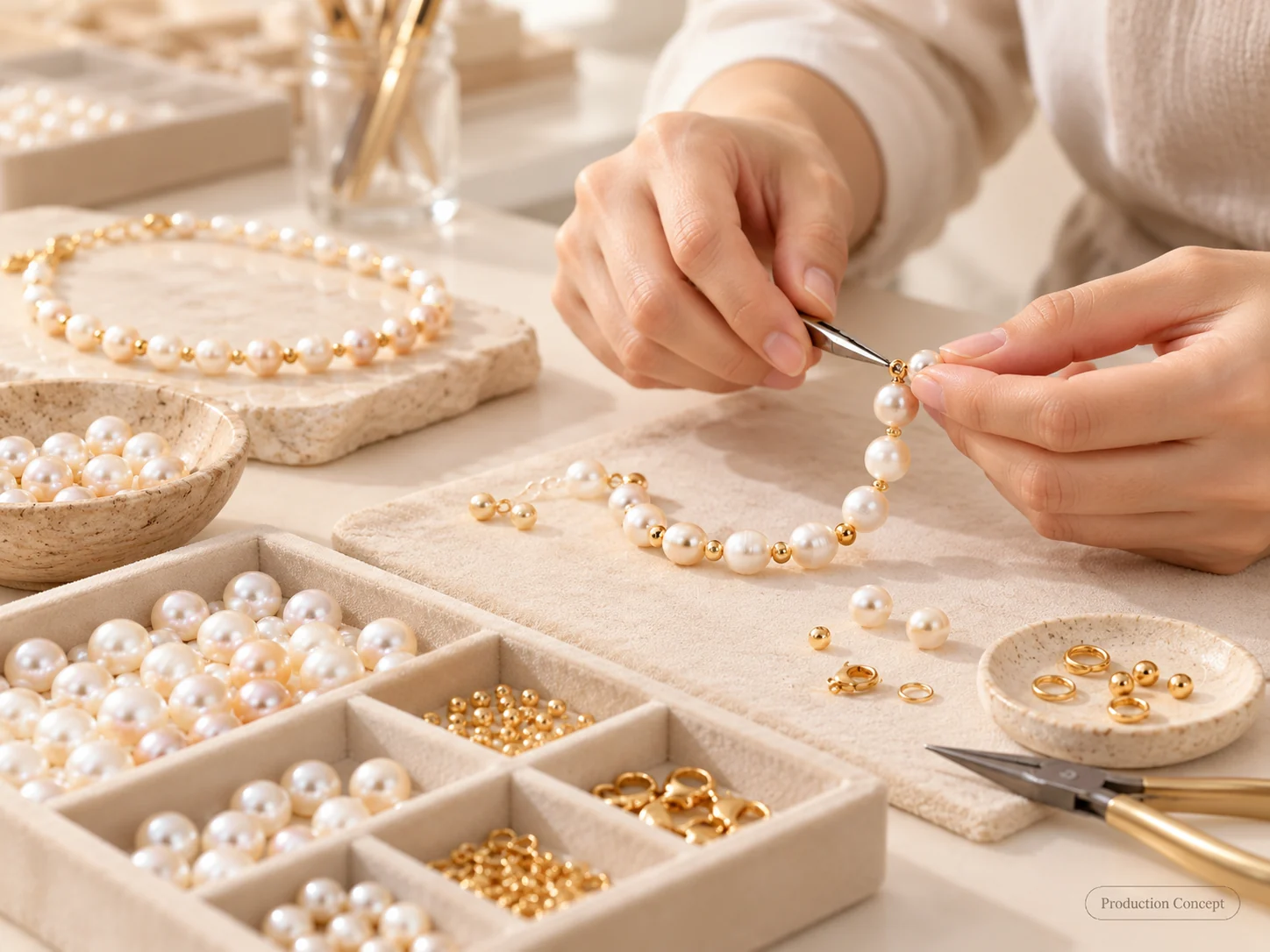
HaoLustra supports B2B jewelry development and manufacturing in Qingdao, China, for brands, boutiques, wholesalers and sourcing teams. For buyers looking for a pearl jewelry manufacturer in China, our focus is the manufacture of finished jewelry using specified pearl components—not cultivation of the pearls themselves.
Brands seeking a freshwater pearl jewelry manufacturer in China can discuss collections using cultured freshwater pearl components; we also support finished fashion jewelry made with imitation pearls. We help review the design brief, coordinate component specifications and sample requirements, plan manufacturing and discuss private-label presentation and quality expectations.
Before a quote becomes a production commitment, we confirm the selected components and any supplier-dependent matters such as specific grades, treatments, drilling/setting requirements, quantities and timelines. Those facts should be documented for the SKU rather than presented as universal factory capabilities.
Learn more about the wider service scope on our custom jewelry manufacturing page and our China jewelry factory page.
10. What to Include in a Custom Pearl Jewelry RFQ
A clear request for quotation helps distinguish a material option from an approved production specification. Send the information you have; missing details can be identified during review.
On small screens, scroll the table sideways to view every column.
| Share with HaoLustra | Why it matters for pearl jewelry |
|---|---|
| Reference images or drawings; style count | Defines the intended jewelry and collection scope |
| Cultured freshwater or imitation pearl requirement | Prevents a misleading material substitution |
| Desired size, shape, color, visual finish/luster and matching | Sets buyer expectations for sample approval |
| Supplier documentation or treatment questions, if relevant | Identifies information to confirm before claims or labels |
| Metal findings, clasp/post, chain and construction | Defines the finished assembly rather than just the pearl |
| Expected quantity by SKU and any coordinated collection | Supports project-specific material sourcing and quotation |
| Sample reference, branding, destination market and target timing | Helps identify label, presentation and project constraints |
The MOQ for cultured freshwater or imitation pearl designs depends on the actual components, assembly, visual matching demands and order scope; a generic 50-pieces-per-style reference is not a blanket pearl SKU promise. See low MOQ jewelry manufacturing for general quantity guidance and custom jewelry sets if your brief contains a multi-piece set. Any quote should separately clarify relevant material, sample, development and packaging costs rather than assume one fixed rate.
11. Pearl Jewelry Manufacturing Questions
Can HaoLustra manufacture jewelry with cultured freshwater pearls and imitation pearls?
Yes. HaoLustra supports custom finished jewelry using cultured freshwater pearl components and imitation pearl components. These are separate material options; the final pearl selection, finish, sample, order quantity and manufacturing requirements are confirmed for each style.
How is cultured freshwater pearl jewelry different from imitation pearl jewelry?
Cultured freshwater pearls are grown in mollusks through pearl cultivation. Imitation pearls are manufactured to resemble pearls. They differ in material identity, sourcing information and the way a brand should describe them. Neither should be substituted for the other without a new buyer approval.
Does HaoLustra grow or farm freshwater pearls itself?
HaoLustra’s confirmed offer is finished-jewelry manufacturing using pearl components, not an independently verified pearl-cultivation operation. We can review the cultured freshwater component requirements for a jewelry project without claiming to operate pearl farms.
What should I check when matching a pair of cultured pearl earrings?
Review the approved size range, shape, visible luster, color, surface appearance and the orientation of each pearl within the finished earring. Decide whether you want a close visual pair or a deliberately asymmetric result, and record the accepted variation with the sample.
How can I confirm whether cultured freshwater pearls have been dyed or otherwise treated?
Ask for the supplier’s available material and treatment information for the selected component or lot. A photograph cannot establish whether a pearl has been treated. Any required disclosure should be checked against the relevant sales-market rules before a product listing or printed label is approved.
What if the pearl shade or size changes on a repeat order?
Compare the proposed new component with the original approved specification. If the difference falls outside the agreed tolerance or changes material identity, size, finish or appearance, request documented approval or a revised comparison sample before the repeat order is finalized.
What information should I provide for a custom pearl jewelry quotation?
Send the design reference, required pearl type, approximate size and color, matching expectations, metal findings, style quantities, destination market and packaging requirements. We can then identify which component, sample or production details need clarification before pricing and timing are confirmed.
Can HaoLustra supply Akoya, Tahitian or South Sea cultured pearls?
Our confirmed standard project scope currently covers cultured freshwater pearls and imitation pearl components. Akoya, Tahitian, South Sea or natural-pearl requests are not confirmed stock capabilities and require a separate sourcing and feasibility review. We do not promise these materials without project-specific confirmation.
What should I specify when choosing imitation pearls for a branded collection?
Ask for the actual component specification where available, including core composition, coating or surface finish, color, dimensions and attachment details. Approve a physical or documented visual reference, and identify the material as imitation pearls in the product description and brand materials.
12. Discuss Your Pearl Jewelry Collection
Bring HaoLustra a reference image, existing sample or early collection brief. Tell us whether you want cultured freshwater pearls or imitation pearls, the styles you plan to produce and the visual differences your brand can accept. We can review the material specification, sampling needs and production considerations before providing a project-specific quotation.